
St. Lucie County Criminal History Checks
No single search supplies a complete St. Lucie County criminal history. Begin with the Clerk when the question concerns filed charges or a result in Circuit or County Court. Use the Sheriff for an incident report, local background check, booking material, or recent custody. FDLE supplies the Florida repository search. The office that created a record remains the best place to verify it.
- Search the Clerk's Court Case Search by name or case number for local felony, misdemeanor, and criminal traffic cases.
- Open the matching case and compare parties, filing date, charges, docket events, disposition, sentence, and future settings.
- Check the Sheriff jail search for current custody or release during the prior five days.
- Use the Sheriff Archive Center for older Daily Arrest Reports, then request any underlying report from the arresting agency.
- Order the appropriate FDLE product when a Florida-wide repository result or review of your own record is needed.
The official Clerk case interface shows why a precise local starting point matters.
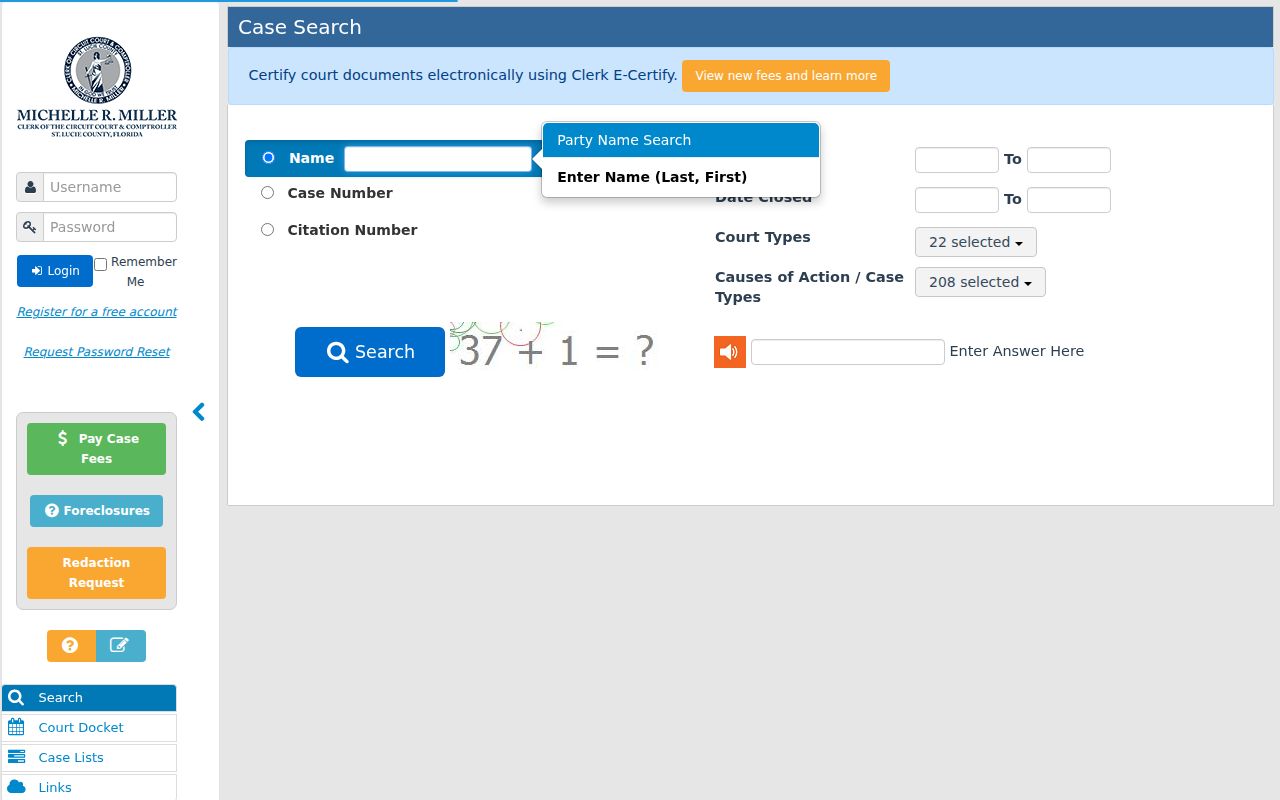
Its case-level detail answers a different question than a jail roster or statewide history.
St. Lucie County Record Custodians
St. Lucie County records are divided by function and place. The Clerk maintains court files at the courthouse complex, 218 S. Second Street in Fort Pierce, and supports many proceedings from the St. Lucie West Annex at 250 NW Country Club Drive in Port St. Lucie. A docket may list Fort Pierce, the annex, or a virtual setting, so confirm the location before a visit.
Clerk of the Circuit Court
218 S. Second St., Fort Pierce, FL 34950
772-462-6900
Case files, court schedules, copies, costs, and dispositions.
St. Lucie County Sheriff
4700 W. Midway Rd., Fort Pierce, FL 34981
772-462-7300; records 772-462-3299
Agency reports, local checks, fingerprints, and registration.
St. Lucie County Jail
900 N. Rock Rd., Fort Pierce, FL 34945
772-462-3450
Booking, custody, housing, release, and bond data.
The Sheriff's official service page illustrates the law-enforcement side of this split.

Directing each request to its custodian prevents a court-record question from being sent to the jail, or the reverse.
Official Background Checks in Florida
The Florida Department of Law Enforcement, Division of Criminal Justice Information Services, is the central criminal-history repository. Its CCHInet public products include Instant Search and staff-produced certified or non-certified results. Each search costs $24; Instant Search adds a $1 card fee. Possible matches can require another payment for each record selected. Instant output can be printed or emailed but is not certified.
FDLE states five business days for a staff-produced non-certified result and six to seven business days for a certified one, plus mail time. ORI Search serves authorized statutory purposes and requires the Originating Agency Identifier supplied by the receiving body. FDLE will not create that number. For an individual checking their own Florida record for accuracy, the free Personal Review uses fingerprints, a signed form, and mail to FDLE. The Sheriff's Midway Road headquarters offers fingerprint services, though the appointment, fee, and ORI fit should be confirmed first.
The FDLE CCHInet search is the state repository doorway.
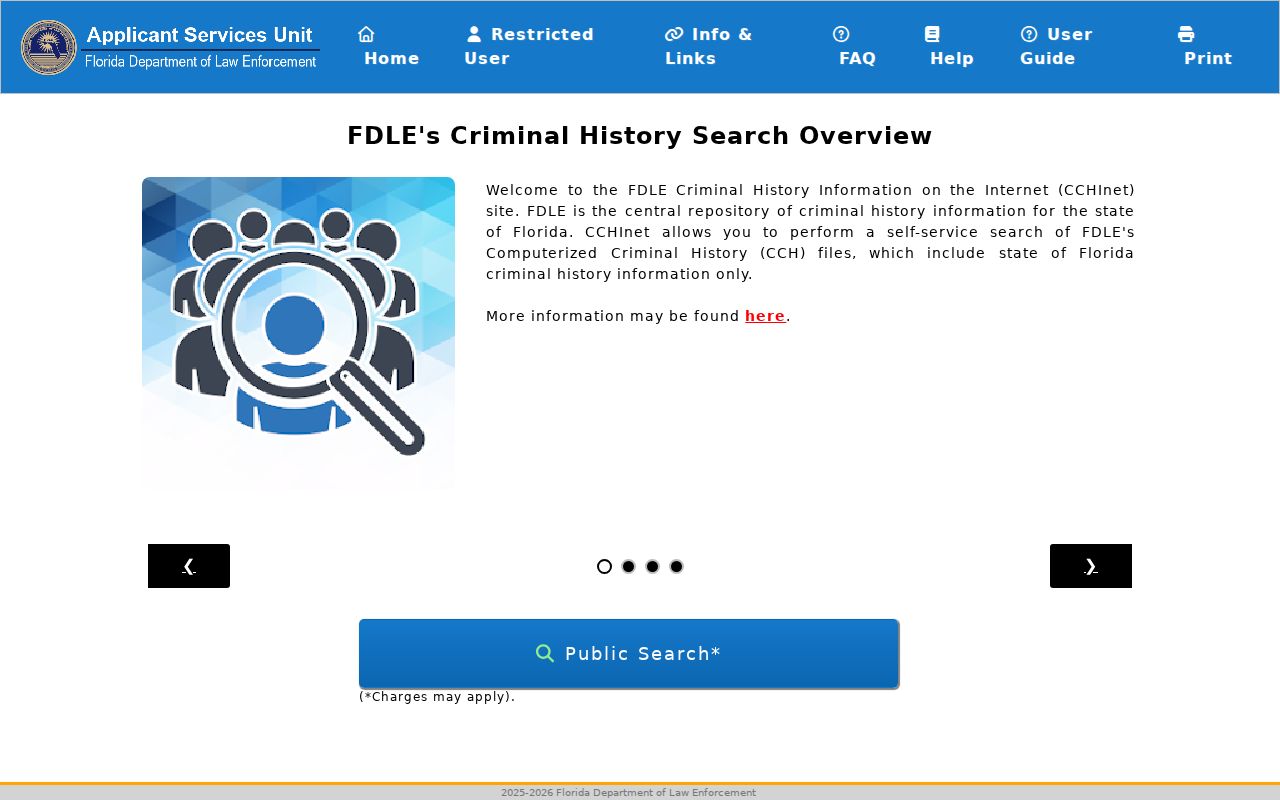
It adds Florida-wide reported events, but it does not replace the richer St. Lucie County court file.
Inside the St. Lucie Case Portal
Most St. Lucie County case information in the Clerk's online system dates to 1993. A name search helps when the case number is unknown; the number gives the cleanest match when available. Common names should be checked against middle name, filing date, division, and other public case details rather than accepted at a glance.
| Search control | How it helps |
|---|---|
| Name or Case Number | Selects the basic search method. |
| Last, First, Middle Name | Supports partial names and narrower identity matching. |
| Case Number | Targets a known local file, often with year and division code. |
| Court or Case Type | Separates CF felony, MM misdemeanor, CT criminal traffic, and other divisions. |
| Date range | Helps distinguish people and locate archived activity when offered. |
Ordinary public searching does not require registration. An electronic-access account adds tools, but Rule 2.420 and Florida's access matrix still restrict certain material. The Clerk Research Department is the fallback for records or images not exposed online, and the Clerk asks users not to duplicate one request across several channels.
Kinds of Criminal Records
St. Lucie County agencies create separate records as a matter moves from allegation to final result. A police incident report describes what was reported and what officers did. A booking file documents jail intake. The State Attorney's information states the formal charge, which can differ from an initial arrest allegation. The Clerk's case file then records court action.
- Incident or arrest report: narrative, time, place, witnesses, officer action, and arrest basis, subject to exemptions.
- Booking record: intake identifiers, charges, arresting agency, custody, housing, and bond.
- Court case file: pleadings, orders, events, costs, disposition, sentence, and future settings.
- FDLE history: fingerprint-linked Florida arrest cycles and reported outcomes.
- Custody or supervision entry: county jail status or FDC prison and felony supervision data.
These sources can disagree for ordinary reasons. Prosecutors may change a charge, reporting may lag, and an agency identifier may fail to link a disposition to its arrest cycle. Verification means reading the source that owns the particular fact.
St. Lucie County Jail Time Windows
The Sheriff jail search covers people now in county custody and those released during the preceding five days. It accepts partial first or last names, offers an Only Today's Bookings box, and requires acceptance of its disclaimer. Entering a percent sign in the Last Name field returns all people in the current scope. The result can show inmate ID, booking and arrest data, arresting agency, housing, charge status, count-level bond, and total bond.
The official St. Lucie County inmate search makes the live roster's narrow time span visible.
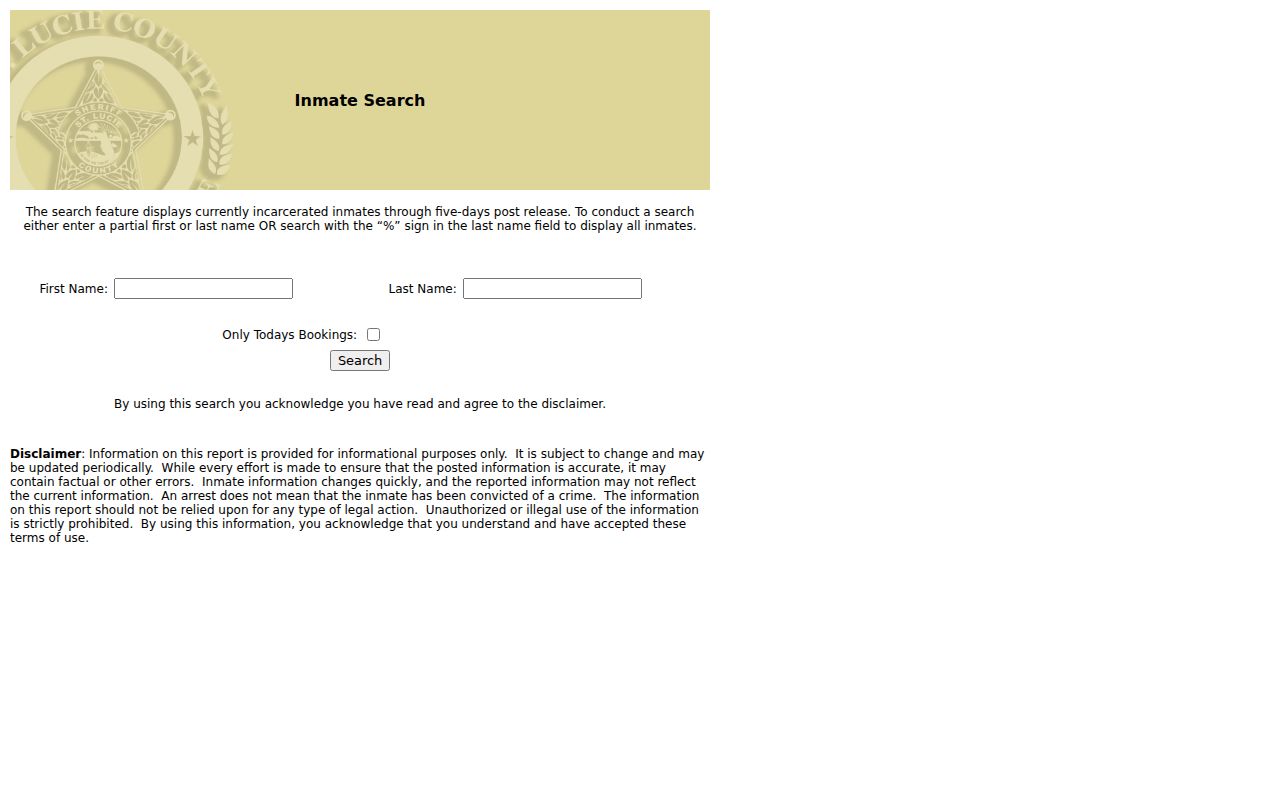
After the five-day release window closes, the Sheriff Archive Center's Daily Arrest Reports become the historical lead. Neither source establishes guilt. The Clerk file is the place to learn whether prosecutors filed a case and what result followed.
St. Lucie County Criminal Records: What They Contain
A full St. Lucie County criminal record can contain several layers rather than one fixed profile. Identity fields connect the correct person to an event. Arrest and booking fields show the first custody stage. Court fields show the accusation chosen by prosecutors, the judge's orders, and the final outcome. The level of detail depends on which custodian produced the result.
| Name and Identifiers | Name, aliases, date of birth, sex, race, and fingerprint-supported state or FBI identifiers where lawfully shown. |
|---|---|
| Arrest and Booking | Date, agency, intake data, initial allegations, custody location, and bond fields. |
| Charges and Statutes | Count, description, Florida citation, degree, filing decision, and changes to the charge. |
| Disposition | Nolle prosequi, no information, dismissal, acquittal, plea, withheld adjudication, or conviction. |
| Sentence | Custody, credit, probation or community control, fines, costs, and restitution when entered. |
| Custody or Supervision | County detention, FDC prison, felony probation, community control, or release status. |
A withheld adjudication is not a dismissal, and a dismissal does not erase an accurate arrest event. Those distinctions are why the case docket and count-level disposition deserve close reading.
St. Lucie County Warrant Fallbacks
No complete public active-warrant database was verified on the St. Lucie County Sheriff's website. A careful search therefore follows several official points. Check the Clerk case for warrant or capias docket entries, call the issuing division when identified, and contact the Sheriff's Records Custodian at 772-462-3299 or submit a focused public-records request. FDLE's wanted-person search can add qualifying statewide entries.
Bench warrants and capiases commonly arise from a missed hearing or court-order violation. Arrest warrants follow a probable-cause finding. Search warrants may remain sealed during an active investigation and are not a public name-search product. Do not travel or surrender based on an unverified web result. Resolution must go through the issuing court and law enforcement, and a payment may not recall a capias until the court processes an order. Confirm clearance afterward.
Florida Public Access Laws
Florida treats access record by record. A person normally need not state a purpose when requesting an existing nonexempt St. Lucie County record, but the custodian reviews responsive material for confidentiality. The law does not require an office to answer research questions, create a new report, or convert data into a form it does not maintain.
Key statutes and rules:
Chapter 119, Florida Statutes opens existing nonexempt local records and permits lawful copy and extensive-use charges.
Section 943.053 authorizes FDLE dissemination and Florida's fee-based public history search.
Florida Rule 2.420 governs public court records and enumerated confidential material.
Section 943.0585 sets the court-ordered expunction process.
Section 943.059 sets the eligibility and effect of court-ordered sealing.
Active investigative material, protected victim data, juvenile information, biometric identifiers, confidential medical records, and sealed or expunged matters are among the categories that can limit release.
St. Lucie County Records Fees
The Sheriff's published fee schedule, effective May 6, 2024, helps a requester choose a narrow scope. A local background check costs $20. Incident and accident reports are $0.15 per page, with one incident report free to a verified victim. A booking photograph costs $5, though it only records intake and is not proof of guilt. Extensive work can add labor or legal-review charges.
| Product or service | Published charge |
|---|---|
| Local background check | $20 |
| Incident or accident report | $0.15 per page |
| Bulk-request deposit | $25 |
| Bulk clerk labor | $28 per hour |
| Legal review | $67.53 per hour |
| Body-camera request | $100 nonrefundable deposit, then $35 per hour |
Body-camera requests are treated as withdrawn if the deposit is not received within 15 days. A focused incident number, location, date range, record type, and existing delivery format can reduce review time. The portal issues a request number and security key for status tracking.
Restricted, Sealed & Expunged Records
Court-ordered expunction and sealing do not happen merely because a St. Lucie County charge was dismissed. Eligibility depends on the exact record, disposition, prior history, and statutory exclusions. Section 943.0584 identifies offenses that block ordinary relief. Section 943.0585 governs expunction, while section 943.059 governs sealing. Florida also recognizes narrower forms of relief for lawful self-defense, trafficking victims, juvenile diversion, and qualifying juvenile destruction.
Sealing keeps the record confidential but retained. Expunction generally removes or destroys ordinary agency records while FDLE retains a confidential limited entry. Juvenile histories are usually confidential, subject to specific release rules. A public search can therefore omit lawful confidential material. Someone reviewing their own state history can use FDLE's free fingerprint Personal Review and challenge an error, but a factually correct event requires the applicable court process rather than an accuracy challenge.
St. Lucie County Custody After Sentencing
A person sentenced to state prison or adult felony supervision moves from local records into the Florida Department of Corrections system. FDC Offender Search covers state custody, felony probation, and community control, not the county jail's pretrial population. Search fields include name, DC number, race, sex, and age range; results can show status, location or supervision office, offense, sentence dates, and release or termination dates.
The FDC Offender Search form demonstrates that statewide custody and supervision are a later layer.
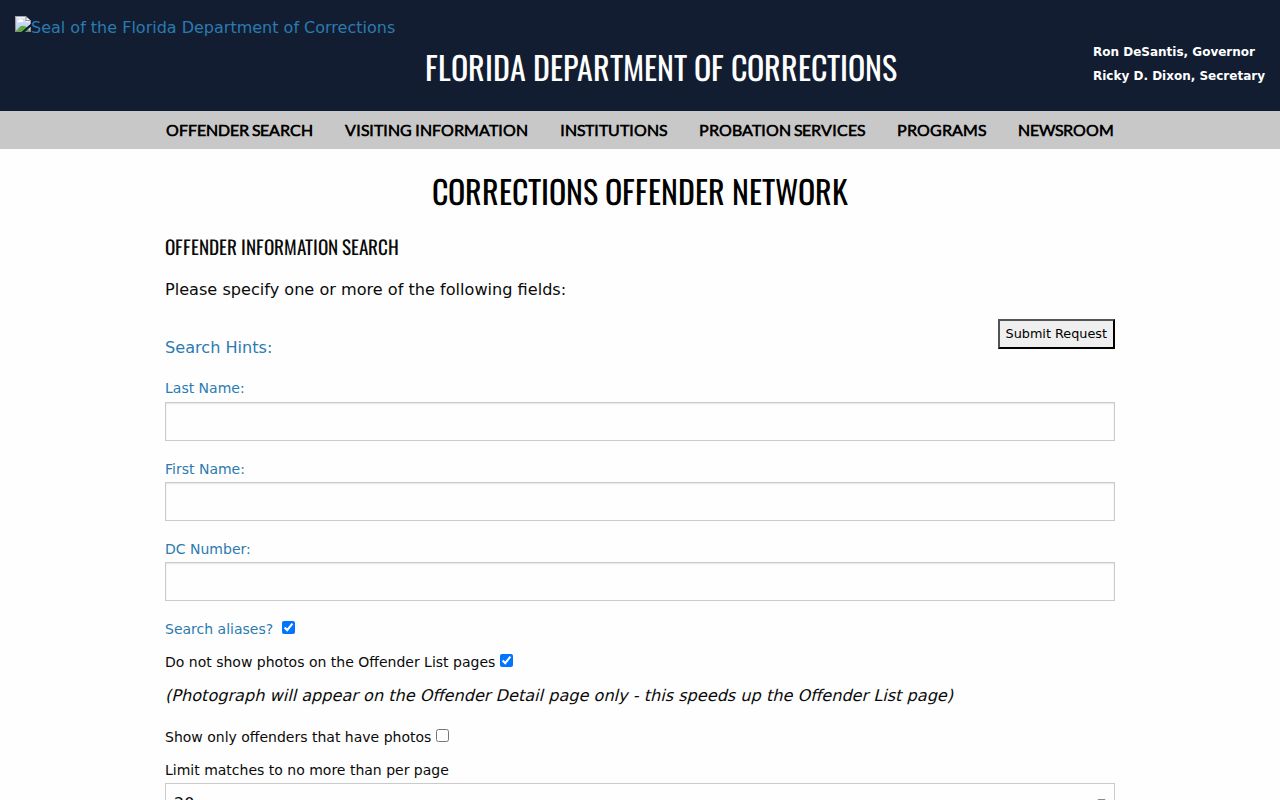
Use the Clerk's sentence for the court order and the FDC result for current state supervision. Probation notes and treatment data are not ordinary public lookup material.
St. Lucie County Registry and Appellate Layers
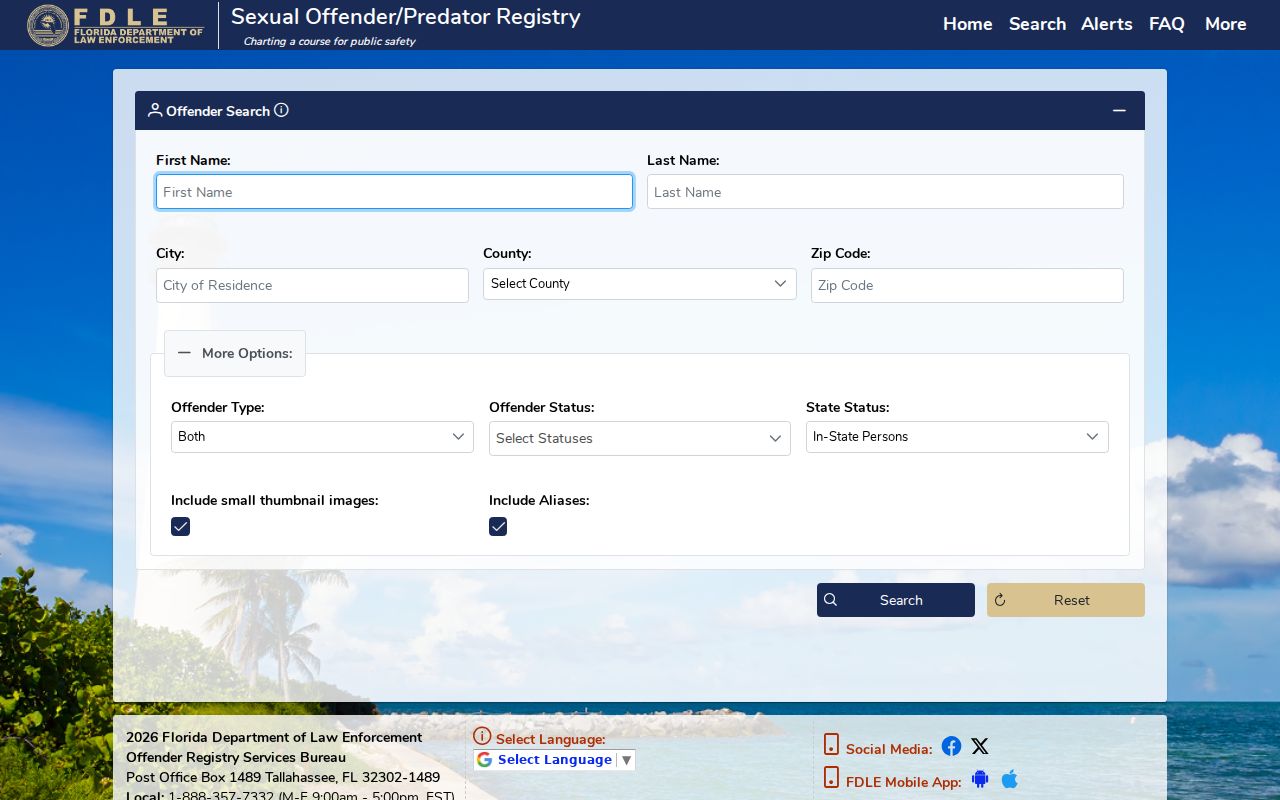
FDLE's Florida Sexual Offenders and Predators Search allows name, city, county, ZIP, and neighborhood criteria. Selecting St. Lucie County can return a geographic list when names are left blank. Public profiles may include a photograph, aliases, statutory designation, public address, qualifying offense, vehicles, marks, and registration status. They do not publish collected Social Security numbers, fingerprints, or palm prints.
The official Florida registry interface shows the geographic search choices.
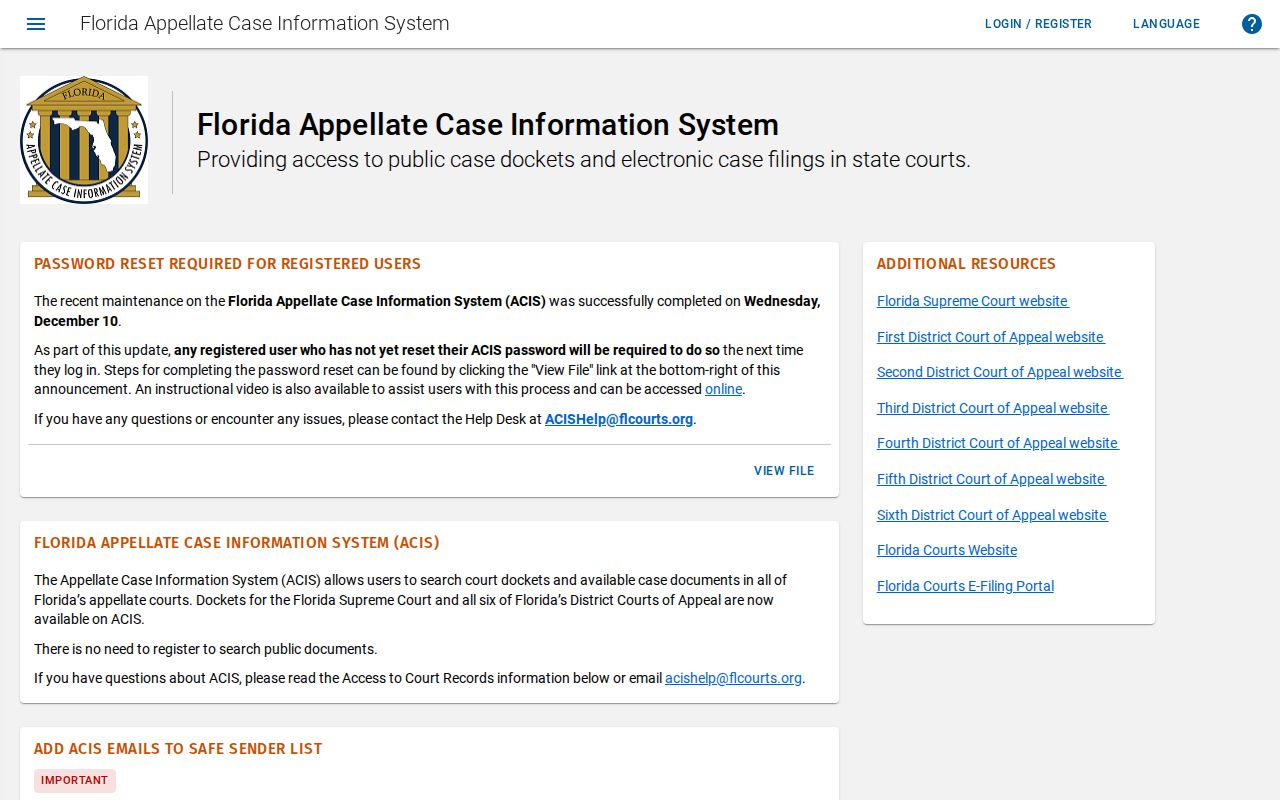
For Supreme Court or District Court of Appeal activity, Florida's ACIS is a separate public system.
The Appellate Case Information System displays the statewide appellate search layer.
Neither system substitutes for the St. Lucie County trial-court file. Registry data supports safety awareness and must never be used for threats, harassment, or confrontation.
City-by-City Criminal Records in St. Lucie County
St. Lucie County has three incorporated places. Port St. Lucie and Fort Pierce operate police departments that retain their own incident records before a criminal prosecution reaches county court. St. Lucie Village relies substantially on county arrangements and has no comparable full-service police records portal. The correct city starting point depends on which agency created the event.
Port St. Lucie Record Check
The city records center accepts online, in-person, email, mail, phone, and fax requests.
Fort Pierce Record Check
Police and city records route through Fort Pierce's official public-records channel.
St. Lucie Village Record Check
Village inquiries often lead to the Clerk or Sheriff's county systems.
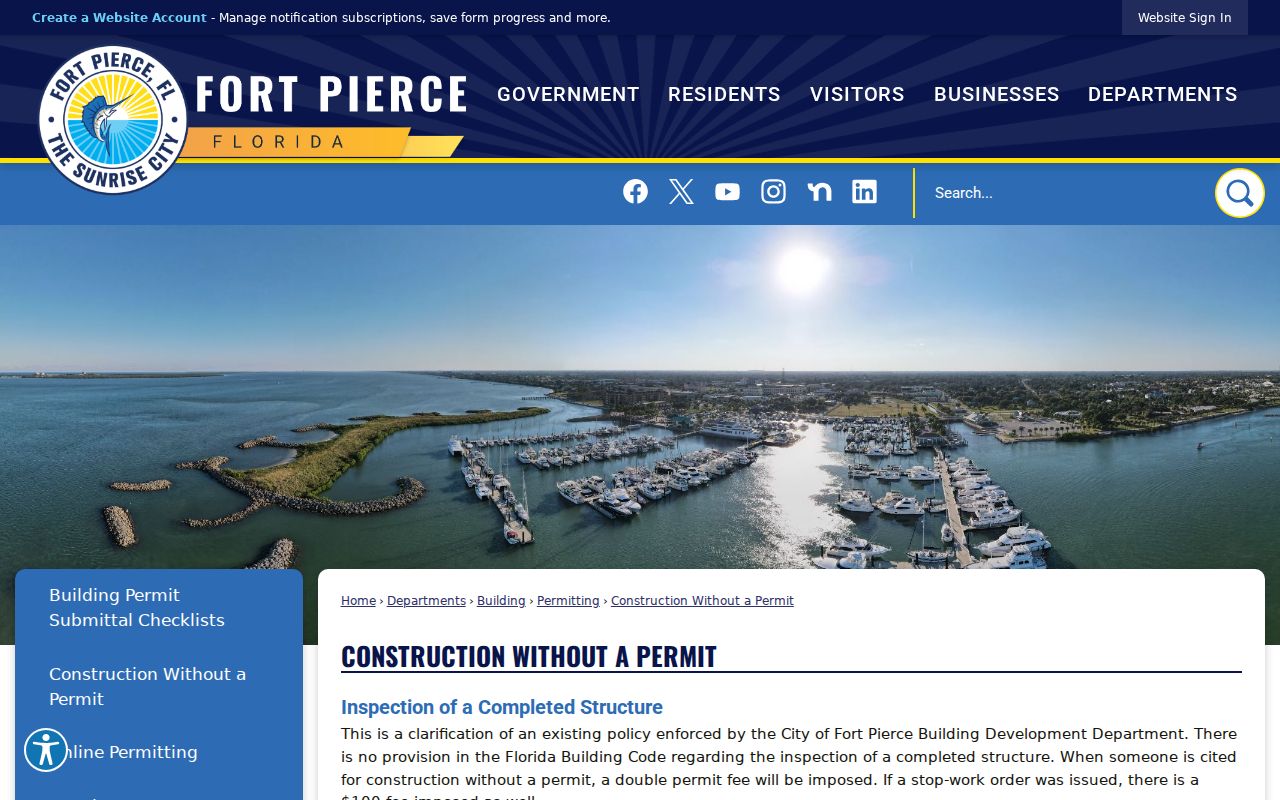
The Fort Pierce Police Department page provides a visible example of a city-level source.
City reports remain distinct from the court docket and FDLE history even when they describe the same event.