
Port St. Lucie Criminal History Checks
Begin with the event, not a broad name search. Port St. Lucie Police holds its incident narratives and arrest reports. The Sheriff holds the booking created after transport to the county jail. The St. Lucie Clerk holds the felony, misdemeanor, or criminal-traffic case if prosecutors filed charges. FDLE adds a Florida-wide repository check when local sources are too narrow.
- Ask PSL Police Records for the report tied to the city event.
- Give the report number, date, place, involved person, and desired format.
- Search the Sheriff jail site for current custody or a recent release.
- Search the Clerk by name or case number for filed charges and results.
- Use FDLE CCHInet when the question extends beyond St. Lucie County.
Six Port St. Lucie Request Routes
The Public Records Center accepts requests online, in person, by email, USPS mail, telephone, and fax. Police Records is 772-871-5047, the City Clerk is 772-871-5157, and the fax is 772-344-4094. The counter is at 121 SW Port St. Lucie Boulevard, Port St. Lucie, FL 34984.
A useful request gives a date range, incident number, location, involved person, department, media type, and delivery choice. The city supplies records in the format it maintains and need not create a custom report.
The official request page illustrates those city routes.
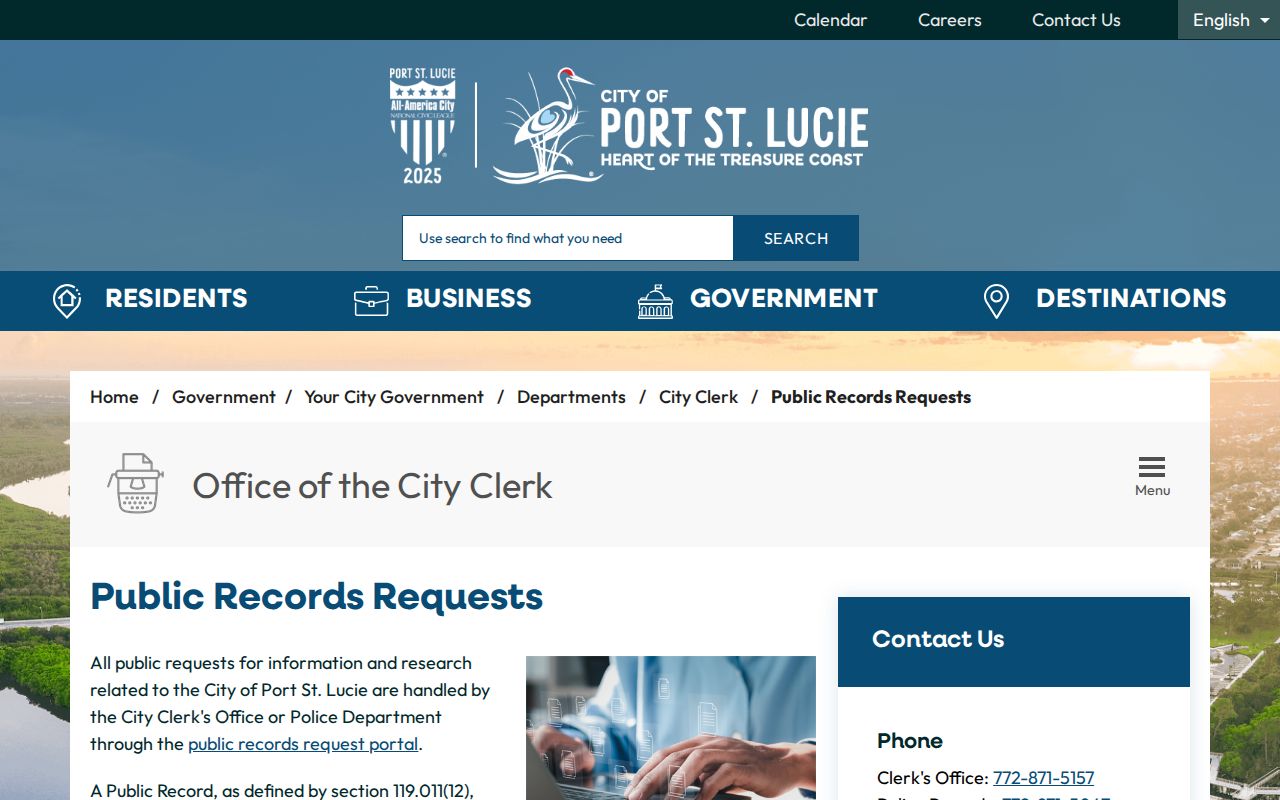
Those choices provide a fallback when the online form is not convenient.
Records at Port St. Lucie Police
PSLPD creates the city report. That file may include the narrative, officer action, listed parties, and media that survives exemption and redaction review. It is distinct from the Sheriff booking profile and Clerk docket. Ask for the needed component instead of using the vague phrase “all records.”
The official Police Department page identifies the agency responsible for those files.

Its city role ends where county booking and prosecution records begin.
Port St. Lucie Labor Charges
City guidance says less than 30 minutes of staff time generally brings no labor charge, though duplication can still cost money. More than 30 minutes may incur labor charges. A tight date range and known report number can reduce search work. Ask for an estimate before authorizing a broad request.
This threshold does not promise every short request is free. Media review, redaction, duplication, and record volume can alter the total. Identify the exact maintained record and preferred delivery format.
Port St. Lucie Clerk Records Counter
The Port St. Lucie City Clerk manages municipal public-record channels and can route a request to the city department that maintains it.
The city clerk route is for city-held material, while criminal court files still belong to the St. Lucie County Clerk.
Booking and Arrest Records in Port St. Lucie
PSLPD may make an arrest, but booking enters the St. Lucie County Jail system at Rock Road. The city report explains the police event. The jail profile describes intake, listed charges, bond, and custody status. Search the current inmate lookup and five-day release report, then the Archive Center for older Daily Arrest Reports.
A blank jail result does not prove that no police report exists. Release timing, spelling, intake processing, or an event that did not lead to booking can explain the gap. The county Arrest Search gives fuller booking context.
Port St. Lucie Report or Case
A police report records what officers were told and did. A Clerk case shows what the State Attorney filed and how the court handled each count. Charges may change after booking. Read the docket disposition instead of treating the first allegation as the result.
| Need | Official holder |
|---|---|
| Incident narrative or media | Port St. Lucie Police |
| Custody and booking | St. Lucie County Sheriff |
| Filed charge and outcome | St. Lucie Clerk |
| Florida history | FDLE |
The Port St. Lucie Municipal Court File
Port St. Lucie has no separate municipal criminal trial court. Florida County Court hears misdemeanors and criminal traffic, while Circuit Court hears felonies. City-code enforcement can follow local processes, but a criminal prosecution is searched through the St. Lucie Clerk.
| Court Name | St. Lucie County Court or Nineteenth Judicial Circuit |
|---|---|
| Case Types Heard | Misdemeanors and criminal traffic in County Court; felonies in Circuit Court |
| Case Lookup Channel | Clerk Court Case Search or Research Department |
| What the Docket Shows | Parties, charges, events, public documents, disposition, sentence, and settings |
| Copies & Fees | Confirm format, access, and current cost with the Clerk |
Port St. Lucie West Settings
The St. Lucie West Annex is at 250 NW Country Club Drive, but not every city case is heard there. The live docket can assign Fort Pierce, St. Lucie West, or a virtual courtroom. Always read the location on the current setting.
Today’s Docket accepts a name, case number, or judge and lists the time, place, event, case type, counsel, and judge. Court Administration at the annex is in Suite 217 and uses 772-807-4370.
How Port St. Lucie Records Reach the County
Police create the report. Jail intake creates a booking and sends fingerprints and event data through Florida’s network. The State Attorney decides the filed charge. The Clerk records the prosecution and qualifying outcomes return to FDLE.
Record flow: Port St. Lucie Police › St. Lucie County Courts › Florida Department of Law Enforcement
Recent activity may appear first with police or the jail. The Clerk is the better source for the later result. FDLE is broader across Florida but does not reproduce the full local file.
Port St. Lucie Exemption Forms
Since May 19, 2025, Port St. Lucie honors a public-record exemption only after staff reviews a signed and notarized city form. The procedure applies even when the city honored an exemption before that date. The form asks for the qualifying category, identity and contact details, address information, notarized signature, and optional incident details.
An exemption limits disclosure where Florida law permits. It does not erase every record or change a Clerk, Sheriff, or FDLE file. Contact each custodian that holds the relevant information.
Port St. Lucie Record Request Fields
The city form separates requester contact data from the facts needed to locate the record. Include the responsible department, a clear description, incident or report number, date range, street or location, involved person, requested media, existing file format, and delivery choice. Required flags can change in the live form, so review each prompt before submission.
Keep the description narrow enough for staff to identify a maintained file. A request for a named incident report is easier to process than a request for every item concerning a broad topic. If video or audio is needed, name it. If only the narrative is needed, say so. Retain the request number and any tracking credential the city provides.
Correcting Port St. Lucie Records
An error must be raised with the custodian of that part of the history. PSLPD controls its report, the Sheriff controls booking data, the Clerk controls its docket, and FDLE controls the state repository entry. A change in one system may not update all others at once.
For a missing Florida disposition, first obtain the final Clerk result and compare identifiers. FDLE offers a free fingerprint-based Personal Review for a person checking their own state record and supplies a challenge route. Sealing or expunction is different from correction. A dismissal does not by itself erase the police report, booking, or public court file.
Port St. Lucie Record Access Rules
Florida starts from broad access, but agencies protect sealed or expunged material, confidential criminal-history data, juvenile information, victim details, and active-investigation information when an exemption applies. A custodian may redact protected parts while releasing the rest.
Key Statutes:
Florida Public Records Law - Florida law balances public access with specific confidentiality exemptions..
Florida Code § 119 - Florida law balances public access with specific confidentiality exemptions..
Florida Code § 119 - Florida law balances public access with specific confidentiality exemptions..